The article outlines the tax implications arising from the international assignment of an employee from the European Union company (home company) to Latvia (host company). In such situations, there are usually two options that could be considered: (1) secondment to Latvia and (2) local employment contract.
1. Employee is seconded to Latvia
In this case, the foreign employee continues to work under an employment contract with the structure of the country of origin, which pays him/her a salary, as well as social and health contributions applicable in the relevant country. The company then re-charges its costs to the Latvian company. There is no employment contract between a Latvian company and this employee, thus only the party of the country of origin has the right to perform legal actions with him. In such situations, it is widespread for a foreigner to use a company car for both work and personal needs.
In this case, the following questions may arise:
- Will the employee remain a resident of his home country for tax purposes?
- Are payroll taxes payable in Latvia, and if so, then:
- registration/reporting requirements;
- possible tax benefits in Latvia for an emigrant (for example, for children, dependent wife, etc.);
- the impact of taxes from the use of a company car for both private and work purposes;
- other tax issues that arise when posting in Latvia, if any.
Residence
According to the Latvian Personal Income Tax Act, a natural person is considered to be a tax resident of Latvia if he or she has his or her habitual residence in Latvia or if he or she stays in Latvia for a period or periods not exceeding a total of 183 days in any 12-month period beginning or ending in the relevant fiscal year. However, if a foreigner works in Latvia, his or her tax residence status must be assessed taking into account the agreement between the particular EU country and Latvia for the avoidance of double taxation, in particular Article 4. In accordance with Article 4 of the double taxation treaty between Latvia and an EU Member State, where a natural person qualifies as a tax resident under the domestic tax rules of both countries, the tax residence of the natural person is determined by the double taxation treaty by successively carrying out the four control points set out in Article 4(2) of the treaty, which are as follows:
- In which country does a person have his or her habitual residence?
- In which country is the center of vital interests of the individual (personal and economic relations)?
- In which country is the person’s habitual residence?
- Which contracting State does a person claim to be a nationality?
When the verification of a particular criterion gives a final answer, the other criteria do not need to be verified. If it is not possible to provide a definitive answer to one of the four criteria examined successively, tax residence to apply the agreement is mutually determined by the tax authorities of the two double taxation treaties.
According to the comments issued by the Organisation for Economic Co-operation and Development (OECD) on the Model Tax Convention on Income and Capital (‘Comments’), ‘habitual residence’ is to be understood as a house or apartment, rented furnished space, owned or rented by a private individual, which is available to a private individual at all times and continuously, and not only occasionally for the purpose of staying, which for reasons is necessarily temporary (leisure travel, business trip, etc.). The location of the center of life interests involves an assessment of all available facts in order to find out with which treaty state the individual has closer personal and economic ties (family relations, political, professional and cultural activities, place of business, etc.). Permanent residence in one country means that an individual stays in that country more often. If there is any doubt as to which country the centre of the individual’s vital interests is located, if the individual resides more often in the same country, then this country is considered to be his country of residence.
The citizenship test can give a final answer about a person’s place of residence in cases where all three previous tests do not allow for a specific determination.
As explained above, if the first test gives a decisive answer (permanent residence is only in the foreigner’s home country), conducting the rest of the contract tests is not required.
Mandatory state social insurance contributions
A foreigner sent to Latvia continues to make social insurance payments only in his or her home country if they are:
- sent to Latvia for a period not exceeding 24 months; and
- has not been sent to replace another designated person; and
- A1 certificate is obtained before leaving the country of origin.
It is recommended that the parties establish social security reporting and transfer obligations before the start of the posting.
Obligation to pay personal income tax (PIT) in Latvia
By the Latvian domestic PIT Law, the remuneration received by a foreigner for performing work duties in Latvia is taxed with PIT in Latvia at the following rates:
- PIT of 20% of income up to EUR 20 004 per year;
- PIT 23% of annual income from 20 004 to 78 100 euros;
- A PIT of 31% is applied to all income exceeding 78 100 euros per year.
Based on Article 3(3)(1) of the PIT Law – employment income, or Article 3(3)(4) of the PIT Law – remuneration of a board member, or Article 3(3)(21) and Article 17(1) of the PIT Law – staff leasing). However, in the case of a foreigner, it is necessary to take into account the provisions of the agreement between Latvia and the EU country on the prevention of double taxation. If the terms contained in a double taxation treaty are more favourable than domestic law, persons may apply the provisions of the double taxation treaty following a certain administrative procedure.
First, Article 16 of the double taxation treaty provides that the director’s remuneration and similar payments received by a resident of one country (i.e. the emigrant’s home country) as a member of the board of directors of a company in another country (i.e. Latvia) may be taxed in that other country (i.e. Latvia). Thus, if a foreigner works and receives remuneration as a member of the board of a Latvian company, then, also based on the PIT rules, the remuneration received must be taxed in Latvia.
Secondly, the provisions of Article 15 of the double taxation treaty should be examined. Article 15 of the Treaty establishes the general principle according to which wages and similar types of remuneration are taxed. Article 15(1) and (2) of the Treaty provides that income is to be taxed in the country where the worker is resident (i.e. in the emigrant’s home country), unless the work is carried out in another country (i.e. Latvia). If the employment is carried out in another country (i.e. Latvia), then the other country may tax such employment income, provided that all three of the following conditions are not met at the same time:
- the employee shall stay in Latvia for a period or periods not exceeding a total of 183 days in any 12-month period beginning or ending in the relevant financial year;
- the remuneration is paid by an employer who is not a resident of Latvia or by an employer who performs it on its behalf;
- the remuneration is not covered by the permanent establishment or permanent base that the employer has in Latvia.
It should also be noted that if the posting is structured as a service contract concluded between the unit of the foreigner’s country of residence and the Latvian unit, it is necessary to take into account the existence of the unit of the foreigner’s country of residence in Latvia. Thus, it is important to ensure that the contract is not considered a service contract to reduce the risk of a permanent establishment in Latvia.
Registration, reporting and payment obligations
Based on the PIT Law, in the case of personnel lease, it is the duty of the Latvian company to:
- calculate the PIT based on information on the gross salary/payment conditions provided by the institution of the foreigner’s home country or included in the contract and additional benefits granted by the Latvian authority;
- transfer PIT payments to the state budget by the 23rd day of the following month (Section 17(10) of the PIT Law);
- for the PIT withheld by the 15th day of the month following the month of disbursement, the following shall be submitted:
- for a resident, a statement on the amounts paid to a natural person, indicating the code of the type of income 1043 “Income of hired personnel”;
- for a non-resident – a report on the income earned and tax paid by a natural person – a non-resident – in the Republic of Latvia, indicating code 15 “Salary”.
If a hired foreign employee is obliged to perform SSIA in Latvia, then the lessee (company) of personnel is obliged to perform the following steps:
- not later than an hour before the hired employee starts work, it is necessary to submit information about employees to the State Revenue Service and register them as employees;
- each hired employee must determine the object of state social insurance bond contributions (VSAOI) and make a calculation by multiplying the object of contributions by the corresponding SSIA rate corresponding to the status of a particular worker;
- by the 17th day of the following month, the employer’s report must be submitted and the amounts declared to the budget must be paid by the 23rd;
- if the leased employee stops working, it is necessary to submit information on the loss of the status of such employee within three working days after the termination of work.
In addition, when transferring payments to non-residents, it is necessary to deduct the PIT. Which party (or natural person) will cover the costs of the Latvian PIT is decided by the foreigner’s state-owned company and the Latvian company.
Benefits
If a non-resident natural person in Latvia obtains more than 75% of his or her total income in the tax year, he or she is granted the following additional reliefs/reliefs:
- annual differentiated non-taxable minimum of the payer (up to 500 EUR/month);
- relief for dependants (250 EUR/month for 1 child);
- eligible expenditure on education and medical services.
Eligible expense benefits/discounts for non-residents are available only after the end of the year by submitting an annual PIT declaration and requesting repayment of the overpaid PIT.
Company car
The purpose of the company car tax is to apply the tax on vehicles that are owned or held by a merchant, a branch of a foreign merchant or an agriculture farm, and are used not only for the performance of economic activity but also for private needs.
Since 1 July 2023, for a vehicle registered for the first time after 1 January 2009 and for which the vehicle registration certificate contains information on the maximum engine power, company car tax shall be paid according to the maximum power of its engine in kilowatts (kW) in the following amount:
- up to 110 kW – 33 EUR/month;
- from 111 kW to 130 kW – 0,30 EUR for each kW/month;
- from 131 kW to 150 kW – 0,35 EUR for each kW/month;
- from 151 kW to 200 kW – 0,5 EUR for each kW/month;
- over 200 kW – 0,70 EUR for each kW/month;
- electric car – 15 EUR/month;
- plug-in hybrid car – 25 EUR/month;
- for cars registered before 01.01.2009 or not with a maximum capacity of 60 EUR/month.
Company car tax is paid by the employer and is not applicable to a natural person.
Potential risk of a permanent establishment
In this option, it is important to ensure that a foreigner does not establish a permanent establishment in Latvia (by Article 5 of the PIT). The below picture illustrates the basic activities of a service company’s (such as an IT company) employees that create a risk of a permanent establishment.
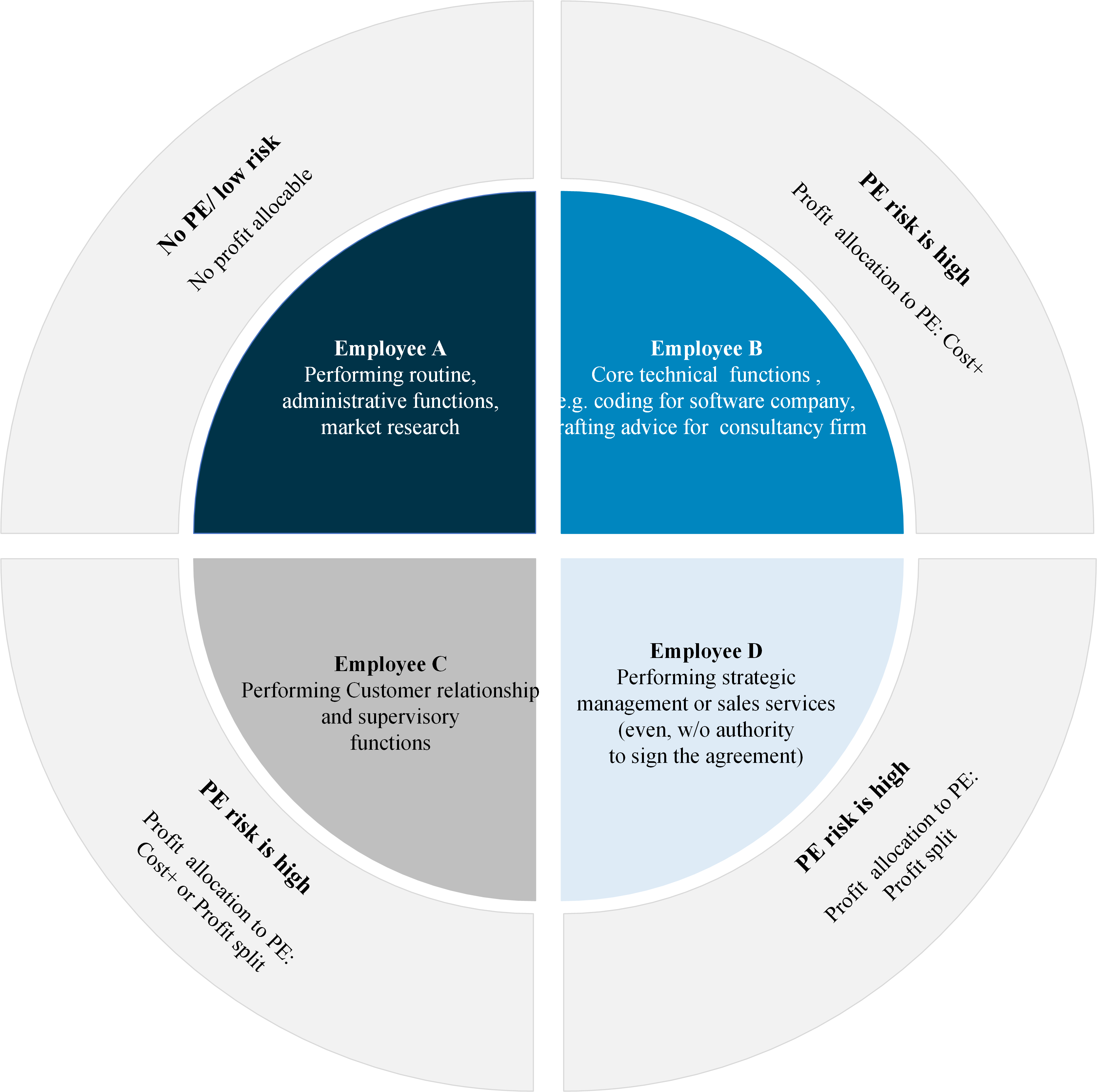
It is also recommended to obtain a valid residence certificate of the employee’s residence unit, which confirms residence in his home country and which must be approved by the tax authorities of both participating countries (Annex 1 to Ministerial Regulation No 178). Such a residence certificate will eliminate the risk of a 10% Latvian withholding tax in accordance with the agreement on “personnel lease” for payments made by the Latvian company to the company of origin of the foreigner.
It is also recommended to stipulate in the agreement between the foreigner’s country of residence and the Latvian unit that the Latvian unit is allowed to withhold payroll taxes from the service fee paid to the unit of the foreigner’s country of residence.
2. Local employment contract
A foreigner enters into an employment contract with a Latvian company by this opportunity. Latvian labor legislation establishes essential employment standards, setting the specified minimum salary, entitlements to paid leave, and other relevant provisions. As of 2024, the minimum salary is 700 EUR for a standard 40-hour workweek. The minimum hourly rate is set using a formula that considers the minimum salary and standard monthly working hours. Please refer to our calendar for more details.
Similarly to option 1, a natural person is subject to progressive rates of Latvian PIT of 20%, 23% or 31%. Since an individual is an employee of a Latvian company, he/she is also entitled to apply for the following benefits every month (not every year):
- social tax withheld from wages and salaries is deductible for PIT purposes, including social tax paid in other EU countries;
- long-term life insurance premiums paid to EU/EEA-based insurers and contributions paid to private pension funds established in the EU/EEA, which together or separately do not exceed 10% of the employee’s gross salary in the tax year.
As in the first option, a foreigner does not have to pay Latvian social insurance contributions if he/she has a valid A1 certificate. Similar to the first option, a foreign employee must submit an annual PIT declaration to claim the following benefits and refund of the overpaid PIT if a non-resident natural person in Latvia earns more than 75% of his or her total income in the tax year:
- annual differentiated non-taxable minimum of the payer (up to 500 EUR/month);
- relief for dependants (250 EUR/month for 1 child);
- eligible expenditure on education and medical services;
- contributions to the employees’ pension fund and life insurance premiums up to 10% of the person’s taxable income. The insurance contract must be for a minimum of ten years;
- health and accident insurance contributions up to 10% of the person’s taxable income, capped at EUR 426.86 a year;
- tax-free scholarships for trainees and meals, and medical expenses up to EUR 480 a year. Certain criteria must be observed, e.g. the required number of employees and the existence of the collective agreement;
- the costs of team-building events are exempt from corporate income tax if they do not exceed 5% of the total gross remuneration in the previous reporting year for which social insurance contributions are paid.
The effect of taxes on the company’s car is the same as in the first option.
Conclusion
The main difference between the two options is the risk of a permanent establishment. This risk should be considered if the employee performs tasks on behalf of the company of his home country. If a Latvian individual is regarded as an employee of a Latvian company, it can be argued that a permanent establishment has not been established. This approach follows from the latest OECD Interpretation Guidelines.
Hiring Remote Employees in Latvia in 2026
Introduction Remote work allows international businesses to recruit in Latvia without opening a traditional office. It does not, [...]
Transfer pricing: can a manufacturer suffer losses?
Preword Manufacturing companies within the group may experience operating losses due to various commercial factors, including adverse market [...]
Alternative dividend taxation regime from 2026 in Latvia. What does it mean for business owners and foreign investors? (video)
General Starting from 1 January 2026, Latvian companies whose shareholders are exclusively individuals can elect a new dividend [...]
Working abroad? What Latvian residents need to know about taxes
If you are a Latvian tax resident and work or have worked abroad, it is important to understand [...]