Along with the amendments to the Commercial Law, which came into effect starting from 2021, the rights of the Latvian liability companies (SIA) regarding capital shares were significantly supplemented, that is, SIA was granted rights to issue multiple capital share categories. From the annotation of the draft law, it follows that the purpose of the amendments was to introduce the regulation equivalent to previously existing regulation of Latvian Joint Capital companies (AS). Also, these amendments to the law granted the right to stipulate different rights for each category of SIA shares, for example, the right to a dividend, liquidation quota, etc.

Taking into account the amendments, companies have the opportunity to offer their employees personnel shares, which give employees only the right to receive dividends (or, in certain cases, the right to expropriate these shares back to the company for a fee). Note that payroll taxes (Social Tax + PIT) are significantly higher than taxes payable on dividends when distributing company profits (CIT).
What exactly are personnel shares?
Personnel shares are a separate category of capital shares of the company. Such shares are granted to company employees and/or board and council members as a motivating tool for a long-term cooperation. Realizing the importance of capable and competent employees in the development of the company, assigning personnel shares is an effective way to ensure that the company’s employees have better working conditions and a motivatng environment.
What rights do personnel shares give?
All the shareholder rights defined in the Commercial Law can be assigned and restricted to the personnel shares. For example, it can be stipulated that personnel shares give the right only to a dividend and don’t give the right to the other rights, i.e. the right to pledge the shares, participate in the increase or decrease of the share capital, pre-emptive rights, voting rights, etc.
Should personnel shares be allocated to staff by payment?
The company is entitled to grant the personnel shares to the employees free of charge and, taking this into account, the granting of such personnel shares does not entail any tax consequences for either the company or the employee. To the extent that such shares are free, their disposal back to the company doesn’t create an obligation to pay taxes as well, because the employee doesn’t receive any income as a result of the disposal. There is also the possibility to assign a value (fee) to the personnel shares, if, for example, the company wants the employee to have the right to dispose these personnel shares back to the company for a fee. Only in this case, the employee will need to initially purchase such shares from the company, paying a price equal to their value. On the other hand, if the company gives such shares to the employee free of charge, then full payroll taxes must be paid for the value of these shares.
Can the company issue multiple categories of personnel shares?
Multiple categories of personnel shares can be created. Individual rights can be assigned to each category of personnel shares, as well as to the amount of dividends. Namely, it is possible that, for example, the category of one personnel share gives the right to receive a larger amount of dividends than the other. In practice, companies often issue multiple personnel share categories and assign them to the employees depending on the positions they occupy. For example, higher-level managers are granted personnel shares, which give the right to receive a higher amount of dividends or additionally give other shareholder rights.
The employee terminates the employment relationship. Do the personnel shares stay with them?
It can be assumed that personnel shares will be transferred to the company upon termination of the employment relationship. It is also possible that the personnel shares may be alienated by the employees at any time at the initiative of the members (or the board), which means that the voting rights of the owners of the company (if any) or any other rights of the actual shareholders in the company are not and cannot be restricted in any way. It is important that if personnel shares were granted to an employee for a fee, then upon termination of the employment relationship or when they are transferred back to the company in another way, the employee must be paid compensation equal to the market value of these shares.
Combining the amount of dividends with the results of the company
What is even more important is that it is possible to combine dividend income from the personnel shares with the company’s results. Namely, the mechanism for calculating personnel dividends can be developed in such a way that the amount of dividends received by an employee who has been allocated personnel shares depends on the company’s results. Referring to the above, companies have the opportunity to issue several categories of personnel shares, applying a different dividend calculation mechanism to each share. This option allows managers of different levels to be assigned different categories of personnel shares with different rights to the amount of dividends to be obtained.
The company wants to pay the employees – holders of personnel shares their due profits in dividends. Does this mean that it is mandatory to distribute profits to all categories of shares?
The voting members have the right to make decisions of the distribution of dividends in such a way that only due to a certain category of shares is distributed, for example, only personnel shares. Namely, this means that the members have the right to distribute the profits in such a way that only the holders of personnel shares receive dividends in the amount they are entitled to.
Example
Taking into account the above mentioned in the article, we have prepared an illustrative example to show how personnel shares work in practice. The company SIA “ZIBSNIS” operates in the production of electrical distribution and control equipment, employing a total of 250 people. 20 of these employees are especially valuable and structurally important for the company, because they have very specific knowledge and competences in their market. These employees would also be very valuable to the competitors of SIA “ZIBSNIS”, so it is vital for the company that these employees perform their duties effectively and are not lured by competitors. To these 20 leading experts, SIA “ZIBSNIS” pays a relatively high monthly salary, which significantly exceeds the average salary in the market. However, in order to additionally motivate these employees to achieve the goals set by the company, the company has given its employees the opportunity to receive a bonus in the amount of 1-3 months’ salary for the annual results, taking into account how financially successful the company’s reporting year has been. SIA “ZIBSNIS” closed the year 2022 with very good results, so in January 2023, the company pays its leading employees a bonus worth 3 months’ salaries. Likewise, SIA “ZIBSNIS” has heard about the possibility of introducing personnel shares in the company and is considering introducing them and paying the bonus to employees in dividends next year, but the company is not entirely clear what the benefit will be so the management of SIA “ZIBSNIS” instructs the company’s accountant and lawyer to carefully study the legal and tax regulation and calculate the potential benefit that the company could gain from implementing personnel shares. After careful research and analysis of the laws, the lawyer of SIA “ZIBSNIS” together with the accountant, has prepared a calculation that shows the comparison between the tax costs, in the current situation and if the bonus would be paid out in dividends.
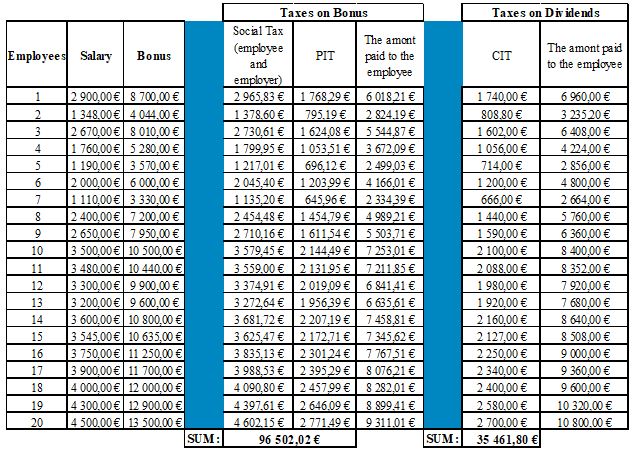
From the table prepared by SIA “ZIBSNIS” lawyer and accountant, it can be seen that if bonuses are issued in the classical way, full payroll taxes must be paid for them. On the other hand, if the company had personnel shares issued to these employees and dividends had been paid instead of bonuses, then only 20% of the CIT would have to be paid from received dividends. The result is significant because, as the table shows, the total tax costs applied if payroll taxes are paid are almost three times higher than if dividends were paid.
Is the idea of introducing personnel parts worth considering?
With a properly developed personnel motivation system, which provides for the allocation of personnel shares, the company is able to significantly save on labour costs, while at the same time motivating the leading, long-term and organizationally important employees, firstly, to achieve the goals set by the company and to be interested in increasing the company’s value, and secondly, to retain these employees so that they are not lured to rival companies. Taking into account that many companies in Latvia currently have a shortage of employees and every employee, especially the leading employee, is vital to them, personnel shares are an effective way not only to retain existing employees but also to attract new ones. Moreover, personnel shares provide the motivation for the employees to care about the company’s growth, namely by following up that the company achieves the highest possible goals and earns the highest possible income, it guarantees a higher income for them as well.
Hiring Remote Employees in Latvia in 2026
Introduction Remote work allows international businesses to recruit in Latvia without opening a traditional office. It does not, [...]
Transfer pricing: can a manufacturer suffer losses?
Preword Manufacturing companies within the group may experience operating losses due to various commercial factors, including adverse market [...]
Alternative dividend taxation regime from 2026 in Latvia. What does it mean for business owners and foreign investors? (video)
General Starting from 1 January 2026, Latvian companies whose shareholders are exclusively individuals can elect a new dividend [...]
Working abroad? What Latvian residents need to know about taxes
If you are a Latvian tax resident and work or have worked abroad, it is important to understand [...]