It’s time for change! The reasons for change are many and varied. In the not so distant past, the need for change in many companies was driven by the epidemiological situation caused by the COVID-19 pandemic, which undoubtedly had a direct impact on the business environment. Experience has shown that many companies in Latvia restructured their businesses as a result of these changes. The current geopolitical situation, which is daily affected by the military conflict with Russia in Ukraine and the resulting sanctions, is also creating uncertainty and concern for the future for a number of companies.

In order to achieve the desired objective and to be effective, restructuring needs to be assessed from a financial, legal and tax perspective by the management and members of the company, so that potential risks to the planned activity can be identified in good time and eliminated or minimised as far as possible.
Business restructuring is not limited to one or two “right” ways. It can be implemented in a variety of ways and may include the reorganisation of group companies.
The purpose of this article is to look in more detail at the various technical and tax nuances of restructuring a business directly between group companies by transferring certain assets and liabilities within the group.
Types of restructuring
Restructuring can take a variety of forms, so management of the company group needs to understand primarily the desired end result that the restructuring is intended to achieve, at the very outset of the restructuring – during a planning phase.
Once the objective of the planned restructuring has been identified, it is then necessary to draw up a specific action plan taking into account the steps to be taken for the restructuring. The first step in drawing up the plan is to understand how the reorganisation will technically be carried out:
This may take different forms. In particular, assets (and liabilities) may be reallocated (transferred) between the companies in the group:
- by reorganisation, in accordance with the rules of commercial law
- by way of a contribution in kind into the share capital
- by sale of the assets (and liabilities) concerned
Each of the listed types of restructuring requires certain preconditions. In other words, each type has its pros and cons, which are important to understand and consider before embarking on a reorganisation.
Reorganisation under commercial law
It is important to stress that reorganisations are not limited to domestic reorganisations. A company may choose to restructure its activities from one country to another in order to reorganise the group structure, to optimise group functions or for tax reasons. Therefore, the legislation of the Member States of the European Union (EU) also includes the possibility of cross-border reorganisations.
The Commercial Code (CC) defines the possible types of reorganisation of limited liability companies (merger, division or conversion) and their order from a legal perspective, while the Corporate Income Tax Act (CIT Act) defines the following three types of reorganisation from a tax perspective:
- Transfer of economic activity
- Merger of companies
- Division of companies
Domestic reorganisation
Based on the CIT Act, Article 18 of the CIT Act applies to the domestic reorganisation process, which provides that the reorganisation does not give rise to tax consequences, if the reorganisation processes set out in the CIT Act (Transfer of Business Activity; Merger of Companies; Division of Companies) are fulfilled, provided that the transferred assets continue to be used by another corporate income tax (CIT) payer for carrying out business activities in Latvia. If these criteria for reorganisation processes are met, the taxable amount for the Corporate income tax does not have to be increased.
In the context of the CIT Act, it is vital in reorganisation processes that the assets and liabilities of the company are reorganised by separating them as a group of items forming an independent business. In particular, for example, when a company transfers a business activity to another related company, the transfer process must involve a complete and accurate transfer of the assets and liabilities associated with that business activity. If the transfer of assets (including intangible assets) does not result in the transfer of all liabilities associated with the assets (including intangible assets), such a transfer of assets may (and often rightly) be treated by the tax authorities as a disposal of assets rather than a reorganisation. In that case, the nature of the transaction is quite different, as the assets have been disposed of to a related party for no consideration, which significantly increases the tax risks.
By complying with and fulfilling the requirements of both the CC and the CIT Act on reorganisation and by reflecting the transfer of assets and liabilities in the closing financial statement, the application of the provisions of the CIT Act can be ensured, so that the reorganisation process is tax neutral and does not result in immediate tax consequences.
If the above requirements are not met and are not complied with, the taxable amount of the assets transferred should include the market value of the assets transferred at the time of their disposal less the liabilities attributable to those assets (except for accrued liabilities attributable to future expenses transferred with the assets to the acquiring company in the reorganisation).
It is also important to note that the carry-forward of certain asset and liability positions should be assessed before the reorganisation is initiated, as tax advantages attributable to those positions may be lost in the reorganisation, such as the right in certain cases to reduce the CIT on dividends by the amount of losses that were not borne during 2017 or the right to company provisions and receivables, but note that in general other tax advantages that are important to identify and define before the reorganisation is initiated may also be lost.
It is also important to assess the provisions of the Value Added Tax Act (the VAT Act) applicable to the reorganisation. Reorganisations are governed by Article 145 of the VAT Act, which provides that no value added tax should be charged on assets transferred by way of division, merger or transformation. In applying the provisions of the VAT Law, it is important that these reorganisations are carried out in accordance with the definitions of the CC.
Cross-border reorganisation
In practice, the cross-border reorganisation process is in most cases complex, difficult and requires a relatively high degree of patience due to its time-consuming nature. Conversely, the reorganisation process is particularly influenced by the requirements of the reorganisation legislation of both countries and the communication and cooperation between the responsible public authorities.
It is important to stress that all reorganisations, including cross-border reorganisations, are neutral from a tax perspective if they comply with the reorganisation requirements of the CIT Act.
The CIT Act does not, inter alia, provide for a definition of a cross-border reorganisation, but it transposes certain provisions resulting from Council Directive 2009/133/EC of 19 October 2009 on the common system of taxation applicable to mergers, divisions, partial divisions, transfers of assets and exchanges of shares concerning companies of different Member States and to the transfer of the registered office of an SE or SCE between Member States.
According to the provisions of the CC, a cross-border merger is a merger of two or more capital companies, at least one of which is incorporated in Latvia and the others are incorporated under the laws of EU Member States.
We point out that in any event, before proceeding with a reorganisation, all the companies involved must assess the potential tax consequences that may arise from taking over or transferring assets and liabilities from one company involved in the reorganisation to another.
Among other things, we highlight that the tax implications vary considerably depending on whether:
A foreign company is being merged into a Latvian company
If a foreign company is added to a Latvian company, it is necessary to assess the financial situation of the acquired company, its liabilities and their expected impact on the finances of the acquiring company. For example, the acquiring company may be adversely affected by the takeover of another company’s accumulated losses for the current year or previous years. This may result in a reduction of the acquiring company’s retained earnings or share capital, which again may have a negative impact on its future plans, for example by limiting the ability to pay dividends.
When preparing a reorganisation plan, it is important to take into account the national laws and regulations governing all taxes of all the companies involved in order to avoid undesirable tax consequences in the future. For example, if a foreign company is added to a Latvian company, the potential VAT consequences for the Latvian company of the added assets under the laws of both countries involved should be assessed, such as the obligation to register for VAT in the foreign country.
Latvian company is added to a foreign company
In the case of a cross-border reorganisation where a Latvian company is merged into a foreign company, particular attention should be paid to the exit tax issue (see exit tax section) and the potential VAT consequences should be assessed. As regards VAT, it is important to make an assessment in relation to the assets to be transferred to the foreign company in the reorganisation. For example, if a Latvian company owning a valuable production asset or immovable property is transferred to a foreign company as a result of a reorganisation, an assessment should be made:
- whether the foreign company is obliged to register for VAT in Latvia;
- whether the foreign company becomes obliged to register a permanent establishment in Latvia, which may again become obliged to register for VAT in Latvia;
- whether the Latvian company is not obliged to make an adjustment and refund of input VAT tax previously deducted.
Exit tax
When planning a cross-border reorganisation, it is very important not forget about the exit tax provisions of the CIT act. Conceptually, the relevant provisions of the CIT act provide that CIT is levied on assets that Latvia loses the right to tax in the future. In other words, if assets are transferred out of the Latvian jurisdiction as a result of a reorganisation (including a business transfer) and Latvia loses the right to tax these assets in the future as a result of this change, the taxpayer must increase the CIT taxable base by the market value of the transferred assets. The exit tax was introduced in the CIT Act in accordance with Council of the European Union Directive 2016/1164 laying down rules to prevent tax avoidance practices directly affecting the functioning of the internal market.
In contrast, if assets are transferred out of Latvia as part of a cross-border reorganisation under the CC, the taxable base includes the market value of the transferred assets at the time of disposal less the value of liabilities attributable to those assets, excluding accrued liabilities attributable to future expenses, which have been transferred to the acquiring company together with the assets in the reorganisation.
An important aspect to consider is when a group reorganisation involving a permanent establishment is planned. For example, if a Latvian taxable person transfers a business activity (transferring all assets and liabilities related to the business activity) to a permanent establishment abroad. In such a case, it should be noted that such a transfer of economic activity – restructuring – is not considered a reorganisation in the context of the CL Act, as the permanent establishment is not legally a separate capital company. From the above, we can conclude that if a cross-border reorganisation is carried out and the business is transferred to a permanent establishment, the criteria of the CIT Act for a reorganisation are not met and exit tax is payable on the transfer of assets to a foreign company.
Material contribution
The CC provides that limited liability companies registered in Latvia may pay for their share capital not only in cash but also by means of a contribution in kind. In the case of a contribution in kind, the investor also receives a number of shares in the company in which the contribution was made corresponding to the value of the contribution.
According to the CC, the object of a contribution in kind may be any thing, corporeal or incorporeal, capable of being valued in monetary terms, or things capable of being used in the business of the company, except for things which cannot be levied on under the law. In the light of the definition of an investment, it follows that an investment may consist of more than one specific asset. It may also take the form of a collection of assets, which may consist of a separate business consisting of specific assets, customers, employees, liabilities, etc.
Before making a property investment, the property investment should be valued and an opinion thereon shall be given by an independent person – an appraiser who is included in the list of property investment appraisers, while the procedure for keeping the list of property investment appraisers and the requirements for appraisers shall be determined by the Cabinet of Ministers.
In any case, the valuation of an in-kind investment from an income tax perspective is considered to be neutral, since in the case of an in-kind investment there is no risk that the transaction itself could be interpreted as something else, such as a disposal. Thus, from the perspective of the CIT Act, a contribution in kind can be seen as a more tax-risk friendly way of transferring a business than a reorganisation.
In contrast, from the prism of the exit tax and VAT risks listed in the previous section, in the case of cross-border restructurings, the transfer of a business (or of certain assets) to another company through an inherited investment should be assessed in a similar way.
Selling a business
Any company or person may sell the assets it owns and the liabilities associated with them, provided that no encumbrance prohibits it. While the purpose of this article is to look at restructuring opportunities within a group of companies, the concept of transfer pricing, which in short states that transactions between related parties must take place at market prices and applies to all transactions between related parties, should not be forgotten.
Specifically, according to Article 4(2)(2)(e) of the Corporate Income Tax Law, the taxable base for corporate income tax also includes income which the taxpayer would have received or expenses which the taxpayer would not have incurred if the commercial and financial relationship had been formed or established on terms which would apply between two independent persons and if the value of these transactions between related persons (one of whom is the taxpayer) corresponded to the market price (value), the methods for calculating which are determined by the Cabinet of Ministers.
The methods and procedure for determining the market price (value) of a transaction, if the transaction is between related persons (within the meaning of Section 1(18) of the Taxes and Fees Law), are set out in Cabinet of Ministers Regulation No 677 “Regulations on the Application of Provisions of the Corporate Income Tax Law”. It should also be borne in mind that not only the transaction price, but also all the terms of the transaction (payment term, default interest, etc.) must comply with the arm’s length principle.
It should be borne in mind that, according to the second paragraph of Article 7 of the VAT Act, the transfer of an undertaking (the transfer of the whole or part of assets and liabilities) to the ownership or use of another economic operator should not be regarded as a supply of goods for consideration if, by transferring assets and liabilities for or without consideration or by investing in the share capital of a capital company or in an investment (capital) of a partnership, the acquirer of the undertaking becomes the transferee of the rights and obligations of the transferor. However, often the tax authorities tend to interpret business sales where no shares are acquired but physical assets (and liabilities) are acquired as a supply of goods subject to VAT. According to the current case law (in the decision of the Senate Department of Administrative Cases in case No SKA-631/2019), in order to recognise the fact of transfer of an undertaking and to conclude that there has been a transfer of an undertaking or an independent part of an undertaking, it is essential to establish that the acquirer has transferred a set of elements of the undertaking which is sufficient to carry out an independent, autonomous economic activity. Consequently, the assessment of the facts in this context must be made by considering whether everything necessary for the continuation of the business has been transferred to the acquirer. The sufficiency of the set of elements depends on the nature of the economic activity in question. A wide variety of circumstances may be relevant to the transfer of an undertaking and it is necessary to assess the substance, rather than the form, of the transactions entered into and the circumstances in which they took place on the basis of the totality of those circumstances. Since the Commercial Code does not allow a situation in which, in a division of the assets of an undertaking, all the assets are transferred to one entity and all the liabilities to another, the existence of a formal agreement between the parties on the transfer of liabilities should not be given decisive weight. Therefore, evidence should be documented before the transaction takes place so that the circumstances of the transaction can be substantiated by the SRS if necessary.
Another important aspect of related party sales is that the parties to the transaction need to settle the business, assets sold. In other words, at the time of conclusion of the sales contract, a right of claim arises which the buyer needs to satisfy.
One of the reasons why large-scale restructurings by sale-only transactions are largely impossible is the lack of free cash with which to pay for what has been acquired.
Example
Below we have created a visual example to illustrate how different types of restructuring can address a company’s stated objective, highlighting the key tax considerations for each type of restructuring.
Situation description: A German tax resident (Mr X) owns a manufacturing company LvCo, registered in Latvia, which is engaged in various businesses, one of which is paper production. LvCo owns a factory in Latvia for the production of paper. LvCo’s paper production is sold in Germany through Mr. X’s German company GerCo. Mr X has reviewed the risk management strategy report prepared by GerCo and LvCo’s management and has decided to transfer LvCo’s paper business to GerCo for risk optimisation purposes. The business is to be transferred together with the mill itself and a bank loan of EUR 1 million, 51 employees and a loss of EUR 300 thousand.
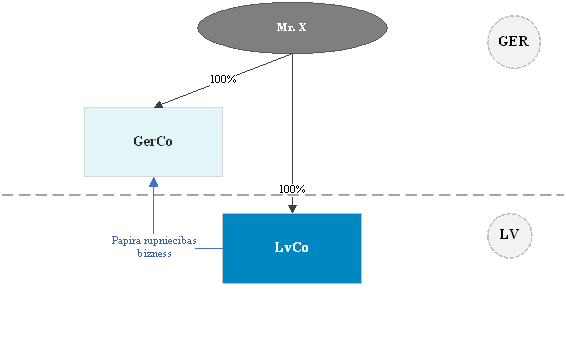
Aim: To understand the most advantageous and convenient way to restructure.
| Alternative 1: LvCo reorganises by demerger, transferring the paper business to GerCo, an already registered company, without going into liquidation.
Important considerations: Before the reorganisation is initiated, it is necessary to understand whether UIT is generated as exit tax and whether VAT needs to be adjusted and part of the input tax refunded back to the Latvian budget. As the reorganisation in question is cross-border, the process is expected to take a long time. |
| Alternative 2: LvCo contributes the paper business as a pool to the share capital of GerCo in return for a number of GerCo shares corresponding to the value of the contribution.
Important considerations: The investment must be made in accordance with German commercial law. It is expected that the investment will be preceded by a valuation and an opinion addressed to the German commercial registry and prepared by a German certified valuer. Following the closing of the transaction, GerCo will no longer be 100% owned directly by Mr.X. In other words, part of the capital of GerCo will be held by LvCo. |
| Alternative 3. The paper business of LvCo is sold to GerCo.
Important considerations: The acquisition must be at market prices and therefore it is necessary to engage a certified valuator prior to the transaction to prepare an appropriate valuation of the paper business owned by LvCo. In addition to the price, the other terms of the transaction must also be subject to the arm’s length principle. LvCo needs to make a physical payment to GerCo for the acquired business. |
Conclusions
The ways in which management and owners of companies can restructure their business are many and varied, and often result in significant benefits for the involved companies.
It is important to remember that the conditions for reorganisation may differ from one law to another. In particular, the conditions defined in the CC may not coincide with those set out in the CIT Act. The VAT Act also provides for different conditions for the reorganisation of a company. It is therefore vital for the management of companies to assess the planned restructuring in terms of the conditions set out in the CC, the CIT Act and the VAT Act in order to identify the potential CIT and VAT risks that may arise for the company, as misinterpreted or not fully understood legal provisions may have negative tax consequences for companies.
It is important to point out that companies can significantly restructure their operations not by carrying out the reorganization required by CL, but by making a property investment.
Hiring Remote Employees in Latvia in 2026
Introduction Remote work allows international businesses to recruit in Latvia without opening a traditional office. It does not, [...]
Transfer pricing: can a manufacturer suffer losses?
Preword Manufacturing companies within the group may experience operating losses due to various commercial factors, including adverse market [...]
Alternative dividend taxation regime from 2026 in Latvia. What does it mean for business owners and foreign investors? (video)
General Starting from 1 January 2026, Latvian companies whose shareholders are exclusively individuals can elect a new dividend [...]
Working abroad? What Latvian residents need to know about taxes
If you are a Latvian tax resident and work or have worked abroad, it is important to understand [...]