The story of a Latvian cosmetic manufacturing company
For some time now, the news appears in the publicly available news about the now-bankrupt former flagship of the cosmetics industry. I don’t want to call anyone names in this article, so let’s call the company by a relative name – “Jūras Dimants” AS.

What is the story about? Jūras Dimants AS was a company with a large market in the former Soviet Union, but with a pile of aging fixed assets and a number of recognizable trademarks in nowdays. In the past, there was much written in the press about the need for Jūras Dimants AS to restructure, modernize, potentially sell, etc., and that its insolvency had objective preconditions. The purpose of this article is not to go through the story of Jūras Dimants AS, but to look at one nuance, namely trademark protection.
According to press reports, during the legal protection proceedings, the beneficiary of the company re-registered the trademarks owned by Jūras Dimants AS in its own name. Without going into the legal details, it is clear that, in any event, if the trademarks are simply transferred without consideration and at a reasonable price, the company is likely to suffer damages. Even in the case where there is a legal basis for the transfer, the company or its creditors would be entitled to claim damages.
It is therefore beyond doubt that it is too late to re-register trademarks when insolvency proceedings take place. I think that it would also be too late to re-register them even if the legal proceedings had not been initiated since in any event the trademarks should be disposed of for a price corresponding to their market value in order not to defraud the company, its minority shareholders (if any) and its creditors.
What can be done to avoid this situation?
First of all, it must be understood that, in order to avoid any questioning of the transfer of trademarks, the trademark must be disposed of for a price corresponding to the market value.
There are several approaches and methods to determine the market price, including cost, comparison, and cash flow methods.
- The cost method is generally applicable when the intangible asset is recently created and has not yet gained popularity.
- Example of the cash flow method. For example, if the royalty rate of a trademark is 1% of turnover, the turnover of the lessee of the trademark is EUR 10 000 000, and the discount rate is 10%, then the value of the trademark at infinity is 10 000 000 x 1% / 10% = EUR 1 000 000. The calculation is approximate but gives some idea of the potential value of the trademark.
- The method of comparison is in fact not applicable in trademark valuations as no two trademarks are the same. The cash flow method is generally used.
So under these circumstances, once a trademark is developed and generating income, it will be expensive. Therefore, if you want to transfer a trademark, it is worth doing so when the trademark is not yet developed, ideally when it is newly created.
As regards transfer pricing for transactions between related companies, where it is difficult to establish a market valuation, the so-called ex-ante and ex-post approaches are applicable.
Ex-ante (pre-transaction) approach
The sooner we think about selling the trademark, the cheaper it will be. Indeed, if a trademark is new and not yet popular, the turnover of the product will be low but will increase as the product becomes popular. Following an ex-ante approach, before the transaction, the potential turnover should be forecasted and the market value of the royalty should be determined.
If the above case is ex-ante or a pre-transaction calculation, the calculation should be made on the basis of projected revenues and justified royalty rate.
Ex post (post-transaction) approach
However, it may be the case that the buyer of the trademark earns a significantly higher turnover, i.e., to return to the example above, of 20 million. This means that the buyer has bought the trademark at a price below the market price. In other words, the ex-post verification of the sale of the trademark shows that the forecast turnover is deliberately inaccurate and incorrect. Such a case is a reason to review the acquisition value of the trademark. On the other hand, if the increased turnover has occurred independently of the forecasts, say the product has proved to be more profitable and popular than expected, then no adjustment is necessary.
For example, continuing the previous example, after 5 years the value of the trademark may be revalued (ex-post approach). If it turns out that the turnover of the goods was 20 million per year instead of the forecast 10 million, the value of the trademark should have been 2 million. The important point here is to understand whether the ex-ante calculation was correct from a pre-transaction perspective. If the forecast was reasonable before the time of the transaction, but for some unforeseeable reason the product turned out to be more popular and the trademark consequently more valuable, then the sales value of the trademark (1 mil) does not need to be adjusted. Conversely, if it was foreseeable that the turnover would be 20 million, it is very likely that the value of the sale of the trademark may be disputed, both by the SRS and by the creditors. Of course, in order for such a challenge to be made by third parties, there must be a specific and demonstrable justification that the original calculation based on the ex-ante approach was incorrect.
Optimal trademark sales and licensing structure
In cases, where a trademark has been sold to an affiliate that licenses it back to the seller, the sale value of the trademark must be aligned with the trademark license fee so that the buyer of the trademark earns an appropriate profit, taking into account the appropriate discount rate due to it, starting from the principle that the transaction must be for a consideration for which an unrelated party would also be prepared to enter into the transaction and, of course, also if it performs any additional functions in the development of the trade mark.
Thus, the sale value of a trademark is essentially the discounted present value of the forecast cash flows. If you want to dispose of the trademark and transfer it to an affiliated company that will take care of it and provides a “haven of peace”, it is vital to first understand its market value.
Based on the example above:
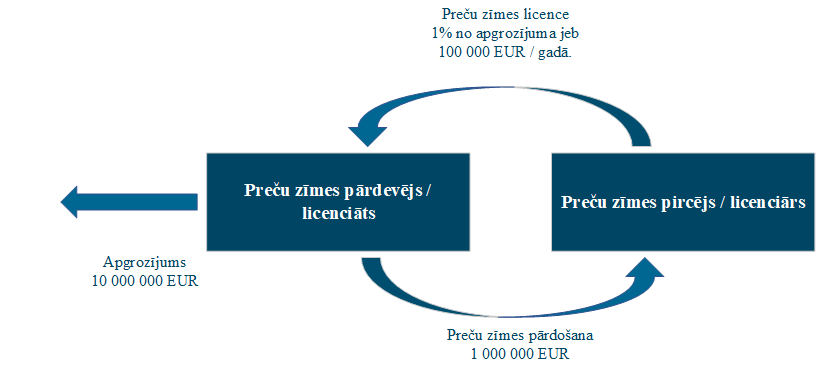
In the optimal structure, the sale-leaseback value of the trademark should coincide with the projected trademark licensing fee discounted at an appropriate discount rate (10% in this example).
How to structure a trademark property?
Intellectual property (IP) must be located (sold) by a separate company. Given the approach of the Latvia tax authority, I would not recommend setting up a company in another country, for example Cyprus, as this involves additional tax risks. IP company might be incorporated in another country if there are other companies in other countries – then it is reasonable to set up an IP company in another country. If you have only one company in Latvia, then it is advisable to set up an IP company in Latvia as well. It can be a holding company at the same time, but it can also be a sister company. However, we do not consider it appropriate to transfer the trademark to subsidiaries as part of group planning. One of the arguments for this is that if for example the operating company which uses the trademark in its business activities fails and is forced into insolvency. In such a case, the trademark would not be protected from the claims of creditors.
It should be borne in mind that the current practice of the Latvian Tax authority and of the EU, in general, tends to eradicate companies that do not carry out an actual economic activity (or, as it is popularly known, companies without substance), but are set up as synthetic structures with only aim to bring economic benefits to their owners. Therefore, when planning the restructuring of a group of companies that, among other things, is to include an intellectual property company, it must be borne in mind that such a company must perform the functions of a DEMPE, i.e:
- Development – product and brand development, planning, and strategy.
- Enhancement – brand awareness, customer experience, and technology.
- Maintenance – ensuring the performance of the brand-customer relationship management, customer feedback, quality control.
- Protection – trademark registration, monitoring, and support.
- Exploitation – Profiting from the use of a trademark.
So the more functions an IP company performs, the more grounded it will be in substance. DEMPE is an initiative issued by the OECD, under BEPS (base erosion and profit shifting). For more details on BEPS, see here: https://transfertcenas.lv/kas-ir-beps/.
Returning to our example of Jūras Dimants AS, the right time to structure the IP was when the company had stable cash flows, including the ability to pay dividends. The owner could then have set up, for example, a holding company to which the trademarks would be sold at the market value. The rights of claim of Jūras Dimants AS arising from the transaction could then be set off against dividends. Of course, there are other options (bank financing, etc.), but it is important to remember that such a structure should be created in good times, not when the company is on the brink of bankruptcy.
Conclusions
Separating the trademark from the operating company can be critical to the business’s survival, especially if the company is in a difficult situation during a crisis. Because once that happens, it’s too late to act (drink the Borjomi).
The longer and more successful the trademark, the higher its value, therefore the more difficult (in other words – expensive) it is to transfer it to an affiliated company because of its market value. Therefore, the sooner you decide to transfer the trademark, the easier it is to do so.
Both the sale and the return to the use of a trademark must be carried out at market value. The market value of the sale corresponds to the discounted expected future cash flow. In addition, the forecast must be fair and based on the current situation; acting dishonestly or carelessly may result in the price of the trademark being revised after the transaction.
Hiring Remote Employees in Latvia in 2026
Introduction Remote work allows international businesses to recruit in Latvia without opening a traditional office. It does not, [...]
Transfer pricing: can a manufacturer suffer losses?
Preword Manufacturing companies within the group may experience operating losses due to various commercial factors, including adverse market [...]
Alternative dividend taxation regime from 2026 in Latvia. What does it mean for business owners and foreign investors? (video)
General Starting from 1 January 2026, Latvian companies whose shareholders are exclusively individuals can elect a new dividend [...]
Working abroad? What Latvian residents need to know about taxes
If you are a Latvian tax resident and work or have worked abroad, it is important to understand [...]