Today, let’s talk about Bruno. No, no, not the character Bruno from the animated film “Encanto”, who was not supposed to be talked about, but our very own Bruno – an investor and entrepreneur. What do the two Bruno’s have in common? They both know how to look into the future, each in his own way, although our Bruno has no magic powers. As tax advisors, we will be looking at Bruno’s vision for the future through a tax lens.
So our Bruno is an investor and entrepreneur with business ambitions, a clear vision for the future, scope and scale. Bruno wants to produce and export emerald puzzles, which are in demand all over the world. Bruno has clear vision and the ability to look into the future, where he sees himself at the head of a multinational group of companies producing emerald puzzles.
What is Bruno’s vision step by step?
Beginning
The first step is the creation of a Latvian manufacturing company. This vision is very easy to create and predict.

So the Latvian company will have a production site. Production costs consist of raw materials, workers’ wages and other costs.
Bruno’s vision is something like this – a million invested, turnover in the first year – 3 million, costs – 1,6 million, profit – 1,4 million. Everything grows by 10% every year. So, in simplified terms, the value of the company in 5 years is 8,5 million (excluding depreciation of cash). For a detailed calculation, see the Annex.
Rapture
After 5 years, when 8,5 million have been accumulated, it is time to take the next step- to buy an emerald mine in an African country instead of buying it at a steep price from suppliers. But since the business is now becoming multinational, and Latvia has no double taxation convention, it is worth considering setting up a holding company in a country that has a tax treaty with this African country.
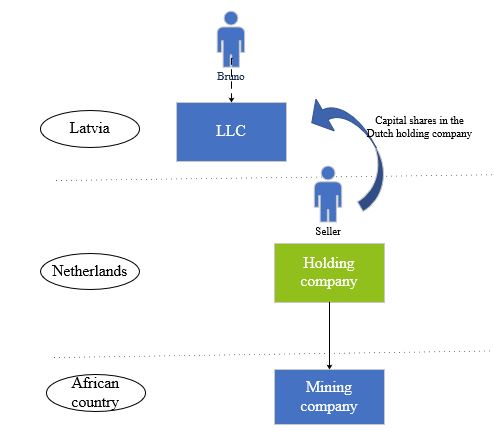
The Latvian company acquires the holding company in the Netherlands, which owns an emerald-mining company in an African country. The purchase price is 5 million.
There are advantages to acquiring a company through a Latvian holding company, as:
- flow-through dividends distributed by an African company will go through a holding company and will not be taxed at the level of the LLC,
- in the event of a sale of the business, the capital gains will not be subject to CIT if the holding shares have been held in the LLC for more than 3 years,
- as an additional benefit, the Holding Company may also have accumulated retained profits om which tax has been paid/exempted in the past, which means that these previously generated profits will not be taxable to the LLC and in the most cases also not to Bruno as an individual. However, it should be remembered that such benefits should not be the only reason for the acquisition. The primary and main reason should be the investment.
The dividend flow from the profits (if any) of the African company and the Dutch holding company is therefore shown in the following drawing.
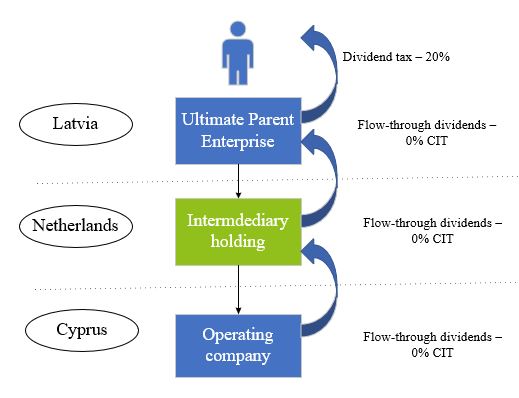
As shown in the figure, African countries will have to pay a corresponding tax on the profits, which are not taxed at any stage. The African company will continue to sell raw materials to the Latvian company. The main benefits will be twofold: a reduction in the purchase price of the raw materials and an increase in volumes.
Assume that in the next 5 years, all the indicators double compared to 2023. and the raw material price decreases from 33% to 25% of turnover. So the annual profit is 3,3 million and the accumulated profit over the next 5 years is around 20 million. So the total value of the company is 15 million.
Maturity
After the rapture phase, the emerald puzzle business develops and people want emerald puzzles in many different countries, which means that there is a need to set up distribution companies (distributors), an intellectual property company in countries where the demand for emerald puzzles is high, and the structure of the group looks like this. The cost of acquiring the distributors is 5 million. The structure of group looks like this.

In other words, the mining sector remains unchanged, but the turnover doubles compared to 2028, which means that the accumulated profit (less acquisition costs) is now 15 + 35 = 50 million. It should be noted that the distribution of dividends in Latvia at company level is still not taking place.
Selling the business
Looking further into the future, Bruno sees that there will come a time when he will not want to take an active part in the business and will sell his international business. This can be done at the level of a Latvian holding by selling shares in the Dutch company. As mentioned above, the gain on the sale of shares is not subject to CIT if the shares sold have been held in the LLC for at least 3 years before the sale. However, the State has stimulated the investment with one hand, but with the other has introduced a rule that such dividends are subject to tax for the shareholder. Assuming that the value of the company corresponds to accumulated profits of 50 million (less acquisition costs), Bruno would have to pay 20% dividend tax, or 10 million.
But this is not a problem for Bruno, who has a clear vision of where he will lead his life – in a country where it is warm, … and where there is no dividend tax. To avoid revealing all the cards, let’s call it Narnia.
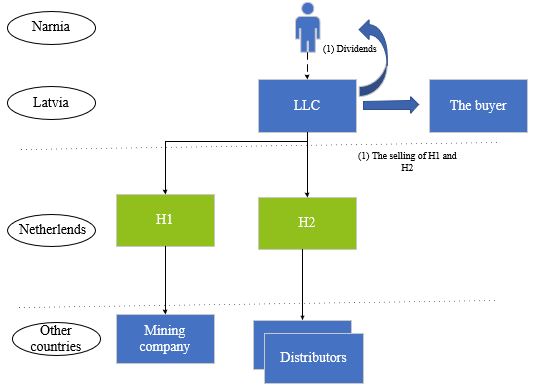
After the change of tax residence, Bruno finds buyers H1 and H2, who hold mining and distribution companies. Bruno wants to keep the IP company and turn it into an investment vehicle. After the sale of H1 and H2, the gain on sale is held in the Latvian company and can be distributed as dividends, subject to the CIT exemption.
The end or a new beginning?
The final phase in Bruno’s vision is the closure and divestment of the Latvian factory. As the factory is also the holding company that owns the IP company, both companies have to be swapped.
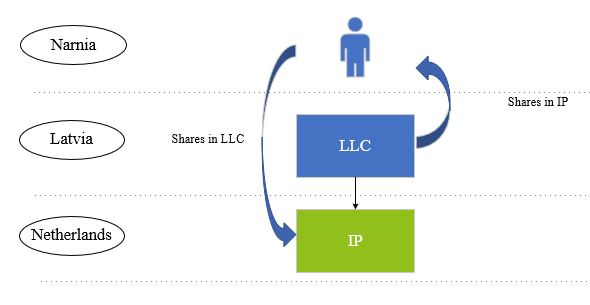
As a result of the share swap, Bruno will own 100% of the shares in IP, which in turn will own 100% of the shares in the LLC. After the share swap, the IP company sell the LLC, which is effectively a production facility, and the consideration for the sale remains in the IP company together with the intellectual property necessary for the success of the business.
Who knows – what if Bruno’s vision turns out to be wrong and he will have to start all over again?
Annex – calculations
If you want to see the figures more clearly, here they are.
Table 1: Beginning
| 2023 | 2024 | 2025 | 2026 | 2027 | |
| Turnover | 3,000,000 | 3,300,000 | 3,630,000 | 3,993,000 | 4,392,300 |
| Raw materials | 1,000,000 | 1,100,000 | 1,210,000 | 1,331,000 | 1,464,100 |
| Labor costs | 500,000 | 550,000 | 605,000 | 665,500 | 732,050 |
| Other costs | 100,000 | 110,000 | 121,000 | 133,100 | 146,410 |
| Profit | 1,400,000 | 1,540,000 | 1,694,000 | 1,863,400 | 2,049,740 |
| Profit margin (%) | 47 | 47 | 47 | 47 | 47 |
| Accumulated profit | 8,547,140 |
Table 2: Rapture
| 2028 | 2029 | 2030 | 2031 | 2032 | |
| Turnover | 6,000,000 | 6,600,000 | 7,260,000 | 7,986,000 | 8,784,600 |
| Raw materials | 1,500,000 | 1,650,000 | 1,815,000 | 1,996,500 | 2,196,150 |
| Labor costs | 1,000,000 | 1,100,000 | 1,210,000 | 1,331,000 | 1,464,100 |
| Other costs | 200,000 | 220,000 | 242,000 | 266,200 | 292,820 |
| Profit | 3,300,000 | 3,630,000 | 3,993,000 | 4,392,300 | 4,831,530 |
| Profit margin (%) | 0.55 | 0.55 | 0.55 | 0.55 | 0.55 |
| Accumulated profit | 20,146,830 |
Table 3: Maturity
| 2028 | 2029 | 2030 | 2031 | 2032 | |
| Turnover | 12,000,000 | 13,200,000 | 14,520,000 | 15,972,000 | 17,569,200 |
| Raw materials | 3,000,000 | 3,300,000 | 3,630,000 | 3,993,000 | 4,392,300 |
| Labor costs | 2,000,000 | 2,200,000 | 2,420,000 | 2,662,000 | 2,928,200 |
| Other costs | 400,000 | 440,000 | 484,000 | 532,400 | 585,640 |
| Profit | 6,600,000 | 7,260,000 | 7,986,000 | 8,784,600 | 9,663,060. |
| Profit margin (%) | 0.55 | 0.55 | 0.55 | 0.55 | 0.55 |
| 40,293,660 |
Hiring Remote Employees in Latvia in 2026
Introduction Remote work allows international businesses to recruit in Latvia without opening a traditional office. It does not, [...]
Transfer pricing: can a manufacturer suffer losses?
Preword Manufacturing companies within the group may experience operating losses due to various commercial factors, including adverse market [...]
Alternative dividend taxation regime from 2026 in Latvia. What does it mean for business owners and foreign investors? (video)
General Starting from 1 January 2026, Latvian companies whose shareholders are exclusively individuals can elect a new dividend [...]
Working abroad? What Latvian residents need to know about taxes
If you are a Latvian tax resident and work or have worked abroad, it is important to understand [...]