Reverse charge VAT
What is the VAT Reverse Charge?
Reverse charge VAT means that the recipient of goods or services declares both the input VAT on the purchase and the VAT due from the supplier. In this way, the buyer declares both the input and output VAT, which are offset against each other and the difference (VAT payable to the budget is zero).
The reverse charge mechanism was developed as a tool to simplify the reporting of transactions between EU Member States and to avoid unnecessary VAT registration in another country.
At the same time, the reverse-charge system means that the buyer of goods or services can deduct input tax only to the extent that he is entitled to recover input tax at all. If the Latvian buyer has no taxable transactions, e.g. the company is a holding company with no taxable transactions, the company will not be entitled to deduct input tax. It will reverse charge VAT (instead of the supplier) but will not be entitled to deduct the input tax in full.
Example
In the example below, the transaction is between a manufacturer of an abstract good and a trader who resells the goods to final consumers (non-payers of VAT) applying the VAT in full amount. Then how will the VAT between the Manufacturer and the Trader be applied if the normal and reverse charge VAT arrangements apply?
General VAT scheme
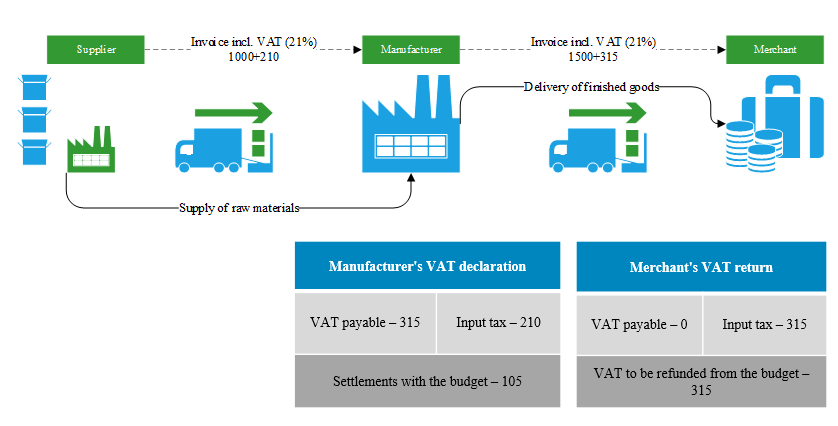
The Manufacturer applies 21% to the delivery of the goods to the Trader. The trader pays the VAT and deducts it as input tax. Consequently, at the time of the transaction, the Trader has a right of claim against the State budget in the amount of this input tax. The Manufacturer, in turn, must pay this VAT to the State budget in the amount of 315.
VAT reverse charge

In the case of a reverse charge VAT system, the Manufacturer is not entitled to collect VAT from the Trader and the obligation to declare the VAT due passes to the Trader. The trader declares this amount (315) as VAT payable and deducts it at the same time so that the VAT payable to the budget is 0. This fact is often misunderstood, since it is as if, contrary to the general principle, in this case, the budget receives no VAT at all. Misunderstandings can arise because the whole transaction chain is not considered. That is to say, VAT is indeed not paid to the budget on the purchase of finished goods, but it is paid at the next stage of the transaction when the trader sells the goods to the end users. For example, if the trader sells the product to the end user without a mark-up, he will charge VAT at the rate of 315 and pay it to the national budget. Therefore, in the case of reverse charge VAT, the liability for VAT in a Manufacturer-Traders transaction is shifted from the Manufacturer to the Trader and the fact that VAT is not collected at the time of the transaction only means that it will be paid at the next stage of the transaction chain for which the Trader is responsible.
When is the reverse charge mechanism used?
Here are some examples from all EU countries where reverse VAT can be applied:
- Intra-community supply of goods (where the goods are sold to a customer in another EU Member State) by another EU-established business
- Supply of services to an EU VAT-registered business in another country
- Imports of goods in some countries
- For certain domestic transactions.
What transactions within Latvia are subject to reverse charge VAT?
The reverse VAT system means that when the supplier invoices the buyer, only the principal amount of the transaction (excluding VAT) is shown. The buyer, in turn, declares this as VAT payable (instead of the supplier) and deducts the input tax calculated. This avoids a situation where an unscrupulous supplier would charge VAT to the buyer and not remit it to the national budget.
For this reason, the reverse charge is one of the most effective mechanisms to combat large-scale VAT fraud. The reverse charge is generally introduced in sectors where the risk of VAT evasion is high, such as the timber industry (both timber supplies and services related to timber supplies), scrap supplies and related services, construction services, or sectors where the flow of goods is difficult to control: certain supplies of electronic devices, the cereals sector and precious metals. In this way, the tax administration can focus on collecting VAT at the end-use stage.
Reverse charge VAT is applicable to the following transactions in Latvia:
- supply of timber and related services (Article 141 of the Value Added Tax Law) – since 1 July 1999
- supply of scrap metal and related services (Article 143 of the Value Added Tax Law) – since 1 October 2011
- construction services (Article 142 of the Value Added Tax Law) – since 1 January 2012
- supplies of mobile phones, laptops, tablets and integrated circuit devices (Article 143.1 of the Value Added Tax Law) – since 1 April 2016
- special tax regime for supplies of cereals and industrial crops (Article 143.2 of the Law on Value Added Tax) – since 1 July 2016
- special tax arrangements for supplies of unwrought precious metals, precious metal alloys and precious metal clad metals (Article 143.3 of the Value Added Tax Law) – from 1 January 2017
- for the supply of construction products (Article 142 of the Value Added Tax Law) – from 1 January 2018
- supply of metal products and related services (Article 143.4 of the Value Added Tax Law) – from 1 January 2018
- supply of household electronic equipment and household electrical appliances (Article 143.5 of the Value Added Tax Law) – from 1 January 2018
for the supply of game consoles (Article 143.1 of the Value Added Tax Law) – as of 1 January 2018.
Reverse VAT accounting
Example. An invoice for advertising services is received from an EU company for EUR 100, showing “reverse charge VAT”. The accounting entries are as follows:
Receipt of invoice:
- Dr – Advertising costs (7179) – EUR 100
- Cr – Settlement with suppliers (5312) – EUR 100
Reverse charge of VAT:
- Dr – VAT settlement (5721) – EUR 21
- Cr – VAT settlement (5721) – EUR 21
| PVN rokasgrāmata |
|
| PVN kalkulators |