In an increasingly interconnected European market, the construction industry frequently operates across national borders. Companies involved in construction services and material supplies often engage in cross-border transactions to meet the growing demand for infrastructure development, commercial projects, and residential buildings. Whether it is a Latvian company purchasing construction materials from a foreign supplier or a foreign business physically providing construction services in Latvia, understanding the tax implications of these transactions is crucial for ensuring compliance and optimizing financial efficiency.
Several factors influence cross-border construction activities, such as the manufacturing of unique construction materials unavailable locally, specialized out, cost efficiency, competitiveness, and the mobility of services. These factors shape the relationship between the supplier and the purchaser.
This article examines the overall tax treatment of construction services and material supplies, covering three key scenarios:
- Supply of construction materials from Poland to Latvia.
- A short-term construction project (usually less than six months) that requires registering a VAT number in Latvia.
- A long-term project (usually over six months) that, in addition to a VAT number, also requires the registration of a permanent establishment.
Supply of construction materials
When an EU supplier sells construction materials to a Latvian recipient, the VAT treatment depends on whether the recipient is VAT-registered in Latvia. The transaction is governed by the EU VAT system, which distinguishes between intra-community supplies and intra-community acquisitions for cross-border transactions within the EU. Below, we analyze both cases: when the recipient has a Latvian VAT number and when they are not a VAT-taxable person.
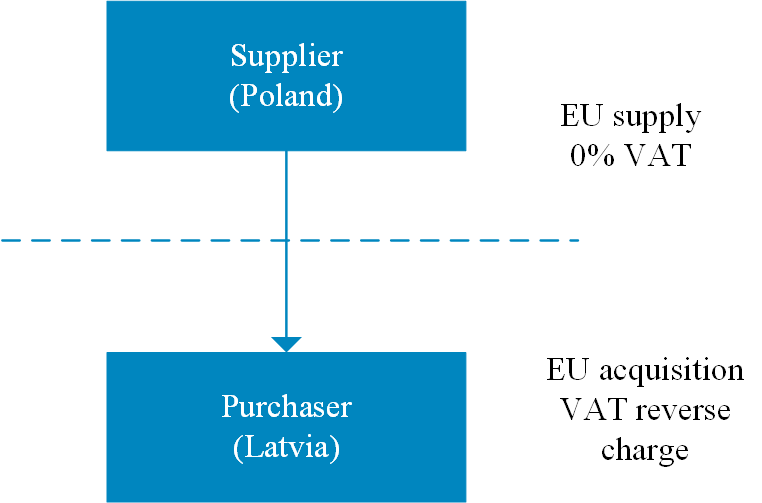
Let us look for the tax implications for both the Polish supplier and the Latvian purchaser.
- VAT Implications for the Polish Supplier
If the Polish supplier sells to a Latvian entity with a VAT number, this qualifies as an intra-community supply, which is zero-rated for VAT in Poland, provided that the Latvian purchaser has a valid VAT number in the VIES (VAT Information Exchange System), the goods are transported from Poland to Latvia (with proper documentation as proof), the transaction is correctly reported in the Polish VAT return and the EC Sales List.
If the Latvian recipient does not have a VAT number, the Polish supplier generally must charge Polish VAT (23%), treating the sale as a domestic transaction rather than an intra-community supply.
- VAT Implications for the Latvian Purchaser
If the Latvian Purchaser is VAT-registered, the recipient must account for VAT using the Intra-Community Acquisition mechanism. This means that the Latvian purchaser self-accounts for VAT at the Latvian rate of 21%, recording output VAT (as if they had sold the goods themselves) and input VAT (which they can deduct, if eligible).
This reverse charge mechanism is cash flow neutral for the Latvian business, provided they have full VAT deduction rights.
If the purchase value is below 10,000 EUR the Latvian purchaser is not required to be a VAT taxable person. In this case, the Polish supplier will apply the Polish VAT, which will not be recoverable by the Latvian company. Therefore, the VAT number is required for the Latvian purchaser to benefit from the intra-community acquisition rules and avoid being charged foreign VAT (23% Polish VAT).
Short-term construction services
The next level following the supply of the construction materials, is a supply of the construction services themselves that include the supply of the materials and making the work on-site.
Under the VAT Act (Article 25), the place of supply of services related to the real estate is the place where the real estate is situated. This means that the foreign contractor has to obtain the VAT number in Latvia prior to starting the construction activities.
The Latvian VAT Act provides a special regime for construction services. When construction services are supplied within Latvia, the reverse charge mechanism applies, shifting the VAT liability from the supplier to the recipient. This rule applies only if both parties are VAT-registered entities in Latvia.
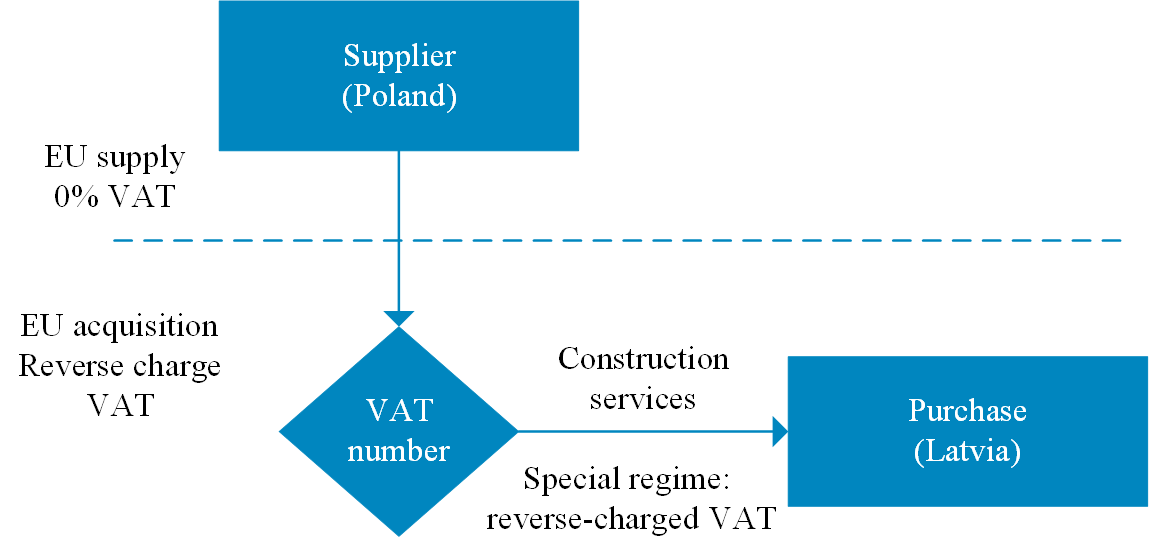
The service provider (Latvian VAT number) does not charge VAT on the invoice. Instead, the Latvian recipient self-accounts for VAT, recording output VAT (as if they were the supplier) and Input VAT (which they can deduct if eligible). This mechanism is intended to prevent VAT fraud, particularly in sectors prone to evasion, such as construction. It also eliminates the cash flow burden for service providers, as they do not need to collect and remit VAT.
If the recipient of the construction services is not VAT-registered, the reverse charge does not apply, and the supplier (Latvian VAT number) must charge Latvian VAT at 21%.
This option does not involve the corporate income tax, provided that the length of the construction site does not exceed the time period as specified in the respective double tax treaties (usually 6-9 months).
Also the for the expatriate employees sent to make construction works, the payroll taxes are payable usually in home country, provided that the stay in Latvia does not exceed 183 days. However, employing the local employees may result in the payroll tax liabilities which are payable either by the Polish company registering as an employer or the employee itself settling their liabilities.
If you would like to find out more, please contact us.
Long-term construction services
A foreign entity is considered to operate through a permanent establishment in Latvia if it carries out activities such as using a building site, construction, assembly, or installation project that lasts more than usually 6-9 months (the exact number of months should be verified in a particular double tax treaty). In such cases, the foreign enterprise is subject to Latvian corporate income tax on the profits attributable to the permanent establishment. Additionally, if the permanent establishment is VAT-registered, it must comply with Latvian VAT regulations, including the reverse charge mechanism for construction services.
This option involves exactly the same VAT implications as in previous option. Unlike the previous option, the foreign entity is considered as a taxpayer in Latvia, which is subject to the corporate income tax and may be subject to the payroll taxes for the employees involved in construction.
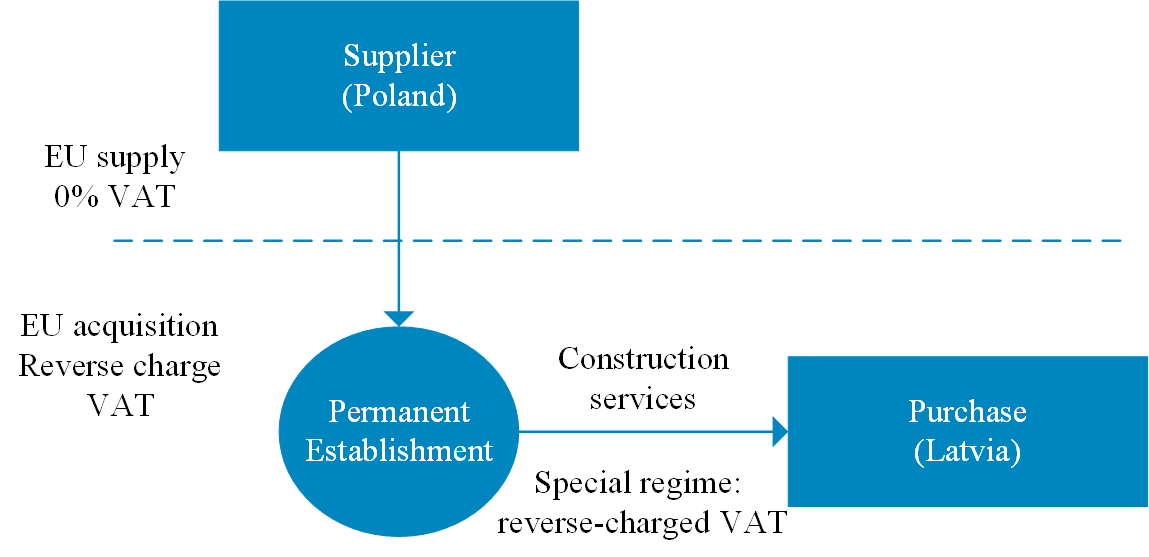
The corporate income tax is payable as the permanent establishment was a separate entity. Therefore, the PE has to prepare the profit loss account, calculating the arm’s length profit margin which is then taxable in Latvia. The main feature of the corporate income tax is that the profit is taxable only upon distribution of profit. So, it is considered that the profit is still undistributed if the PE holds the cash or has accounts receivable in relation to the foreign head office.
Payroll taxes are often overlooked, but there is a high risk that employees sent to Latvia will be subject to payroll taxes from the first day of work. According to the double tax treaty, an employee from the home country (e.g., Poland) will be subject to taxation in Latvia if their remuneration is payable by the permanent establishment in the host country (Latvia).
Mandatory social tax contributions are usually payable in one country. In practice, an A1 certificate is commonly used, allowing social contributions to be paid in the home country for up to two years.
Please contact us if you would like to find out more information about the above situations. please write us info@breicis.com.