Transfer Pricing in Latvia
Transfer Price — you’ve probably heard the term, but what does it really mean?
If your business works with related companies or operates internationally, it’s something you can’t afford to ignore. Today’s a good day to get a clear, simple understanding of how Transfer Pricing works in Latvia. No jargon, just the essentials.
What is a Transfer Price?
Transfer Price is the price applied to goods, services, or financial transactions between related companies. In a global economy, many businesses operate across borders and within corporate groups — and Transfer Pricing helps define how value is allocated among them.
Key Terminology
At the heart of transfer pricing is the market value — the price that would apply if the same transaction were carried out between independent, unrelated parties. This is also known as the arm’s length principle, and it’s the standard used to ensure fairness and prevent tax base erosion.
In Latvia, transfer pricing rules apply to controlled transactions — dealings between companies that are related, either through ownership or control. These rules help ensure that income and expenses are correctly reported and taxed where they economically belong.
Another key concept is the multinational enterprise group (MNE) — a group of companies operating in different countries but owned or controlled by the same entity. These groups are the main focus of transfer pricing regulations, as they have the ability to shift profits across jurisdictions.
Understanding these core terms — market value, transfer price, controlled transaction, and MNE — is the first step in managing transfer pricing risks and ensuring compliance.
Transfer pricing methods
To ensure that transactions between related companies reflect market value, Latvian regulations allow several internationally recognized transfer pricing methods. Each method provides a different way to assess whether the price used in a related-party transaction would be acceptable between independent parties.
Comparable Uncontrolled Pricing (CUP). Compares the price charged in a controlled transaction with the price in a comparable transaction between unrelated parties. Internal comparables are a company’s own third-party deals; external comparables come from market data on other companies.
Resale Minus. Typically used when a company purchases goods from a related party and resells them to an independent customer. The resale price is reduced by a market-based margin to estimate the appropriate purchase price.
Cost Plus. Starts with the cost of producing a product or providing a service and adds a reasonable mark-up to determine the transfer price.
Transactional Net Margin Method (TNMM). Compares the net profit margin from a related-party transaction with that of similar transactions between unrelated parties. Widely used when detailed data for gross-margin comparisons isn’t available.
Profit Split. Used in more complex or integrated transactions, especially when valuable intangibles are involved. It splits the total profit from the transaction based on the value each party contributes, in line with what independent companies would agree.
Selecting the right method depends on the nature of the transaction, availability of reliable data, and the functions, assets, and risks assumed by each party. Taxpayers must be ready to explain and document their chosen method to ensure it aligns with the arm’s length principle.
Illustrative Example
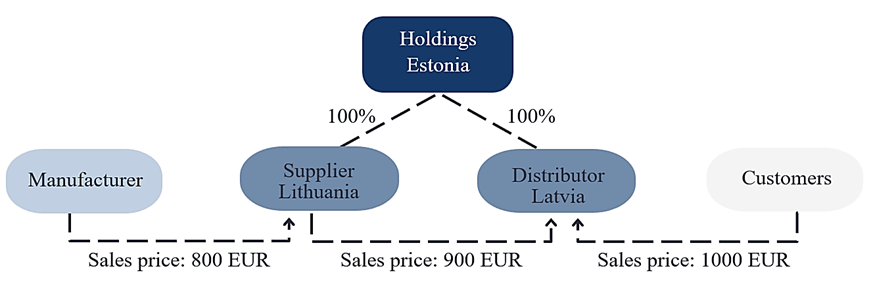
A Latvian distributor buys goods from a related supplier in Lithuania for EUR 900 and sells them to customers for EUR 1,000. After subtracting the purchase cost and EUR 50 in administrative expenses, the distributor ends up with an operating profit margin of 5%.
However, similar independent companies usually earn around 8% profit in this type of business. That means the distributor should have paid only EUR 870 for the goods — not EUR 900 — to stay in line with the arm’s length principle.
To fix this, a transfer pricing adjustment of EUR 30 is made (900 – 870). This increases the distributor’s profit for tax purposes. After applying the standard corporate income tax rate (20%), the company has to pay an extra EUR 7.50 in taxes.
This example shows how important it is to use fair pricing between related companies, as even small differences can impact how much tax needs to be paid.
TP Documentation System
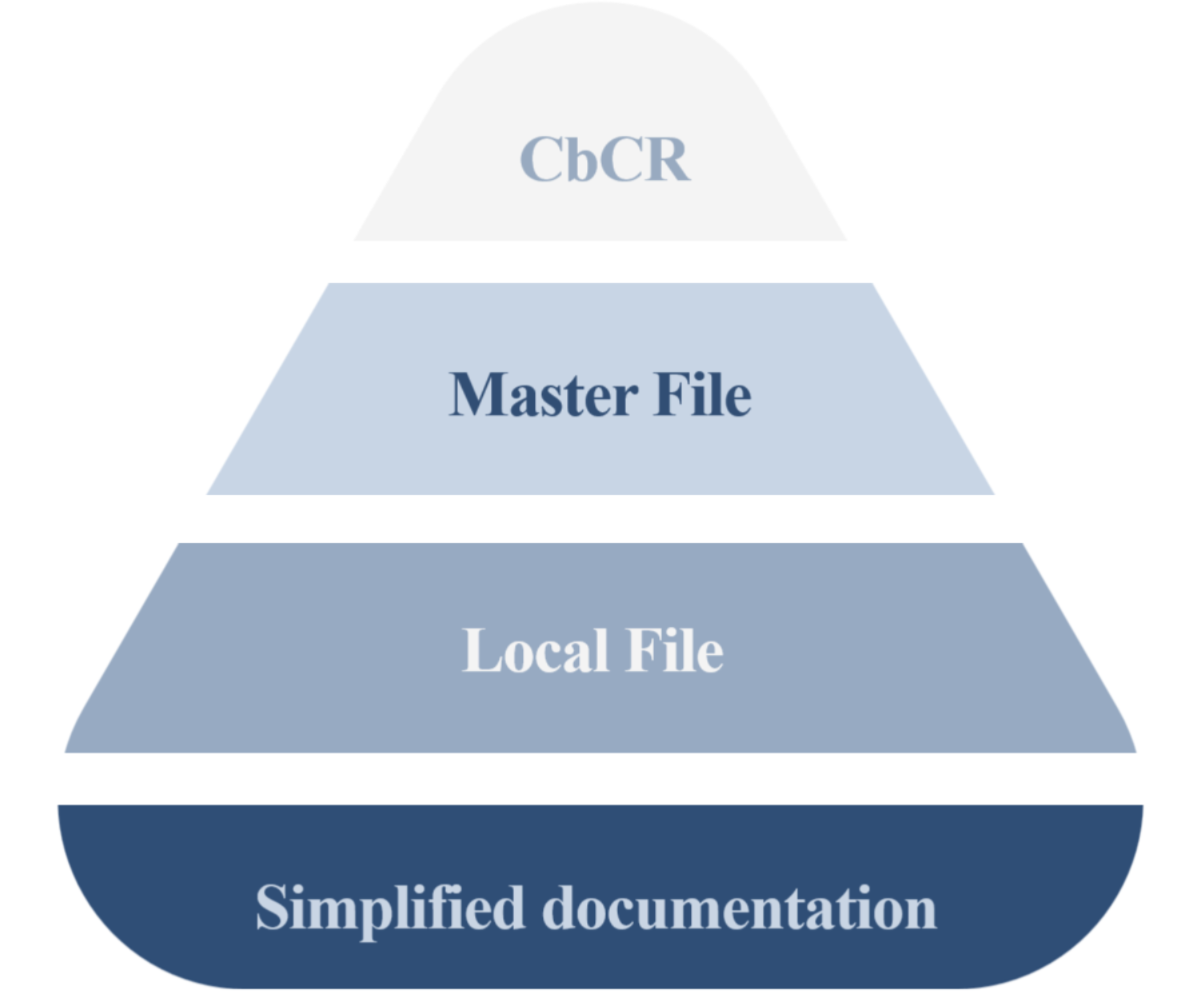
Companies that fall under transfer pricing rules must prepare specific documentation to show that their related-party transactions follow the arm’s length principle. The documentation system is structured in levels, depending on the size of the company and the type of transactions.
Country-by-Country Report (CbCR) applies to large multinational groups and shows how income, taxes, and business activity are distributed across countries.
Master File gives a group-wide overview — including group structure, business activities, intangibles, and financial arrangements.
Local File focuses on the specific Latvian company. It provides detailed information about its transactions with related parties, including pricing, functions performed, and financial results.
For smaller transactions or simpler services, simplified documentation may be allowed. This applies to low value-added services or controlled transactions that don’t meet Local File thresholds, as outlined in Cabinet Regulation No. 677.
This layered approach helps ensure that the right level of information is provided depending on the complexity and scale of the business.
What Laws Regulate Transfer Pricing in Latvia?
Before applying Transfer Pricing rules, it’s important to understand the legal framework behind related-party transactions in Latvia. Aligned with OECD standards, it ensures fair pricing, risk assessment, and tax compliance.
Legal Framework for Transfer Pricing in Latvia
Transfer pricing in Latvia is regulated by a combination of laws and Cabinet regulations that establish clear rules for how transactions between related parties should be priced and documented.
At the core of this framework is the arm’s length principle, as defined in Section 4(2)(2)(e) of the Corporate Income Tax Law.
The definition of related parties is provided in Section 1(18) of the Law on Taxes and Fees.
Requirements for preparing and submitting transfer pricing documentation are detailed in Section 15² of the Law on Taxes and Duties.
The determination of market value is governed by Cabinet Regulation No. 677 (14 Nov 2017).
The content of documentation and the procedure for Advance Pricing Agreements (APAs) are set by Cabinet Regulation No. 802 (18 Dec 2018).
Together, these instruments provide a comprehensive and structured framework for applying transfer pricing rules in Latvia.
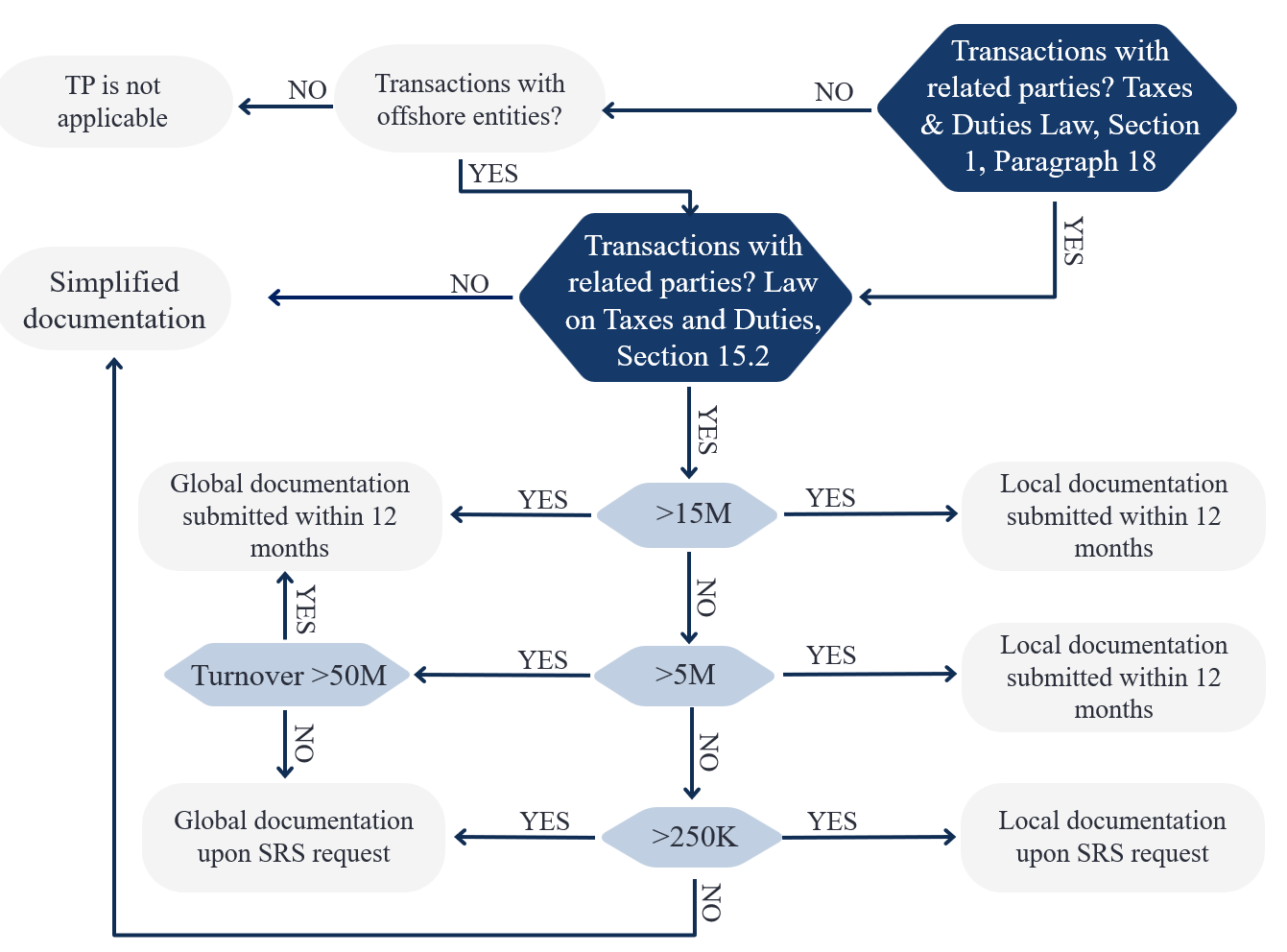
Transfer Pricing Requirements — Decision Tree
We created a practical decision tree to show when documentation is required and which level applies. It reflects current thresholds and real client practice (developed by Artūrs Breicis, BREICIS board member).
Who is Affected by Transfer Pricing Rules?
Now we’ll take a closer look at who is actually affected by transfer pricing rules in Latvia. In the following subsections, we’ll explore which companies and relationships fall under the definition of related parties and when the rules apply.
Related Parties
Under Latvian law, related parties are individuals or legal entities connected through ownership, control, or influence — directly or indirectly. Transactions between related parties are subject to TP rules.
The rules are intentionally broad to capture both legal and economic control.
Parent and subsidiary
Relationship exists where one company holds >50% of shares or voting rights (directly or indirectly). Indirect control includes chains or joint structures where control is exercised through intermediaries.
Direct participation
Latvian transfer pricing rules also consider cases of direct participation where one entity holds between 20% and 50% of another’s shares. However, this threshold only applies when the holding entity is a foreign company. According to Section 18(b) of the Law on Taxes and Duties, if a foreign entity directly owns 20–50% of shares in a Latvian company, the relationship is classified as related for transfer pricing purposes.
In contrast, the same level of participation between two Latvian entities does not create a related-party relationship under transfer pricing rules. This means that Latvian companies holding less than 50% in another Latvian company are not subject to transfer pricing obligations based on this criterion alone.
Control Through Natural Persons and Family Connections
Latvian rules also recognize relationships where control is exercised by individuals. This applies when more than 50% of the share capital or voting rights in two or more companies is held by the same person, or by their close relatives (up to the third degree, including spouses, siblings, children, and in-laws up to the second degree).
A related-party link is also established when several individuals — no more than ten — together hold more than 50% of the shares or voting rights in multiple companies, even if each person’s individual stake is small.
Control Through Board Majority
Entities are considered related when control is exercised through management rather than ownership. If the same person — or the same group — holds a majority of votes in the boards of directors or executive bodies of two or more companies, those companies are related for TP purposes.
Control Through Close Relatives
A related-party relationship may arise when a person — or their close family members — holds control over two or more companies. This applies when a person directly or indirectly owns more than 50% of shares, share capital, or cooperative units, or exercises decisive influence through a contract or other arrangement.
Family members are considered up to the third degree (parents, children, siblings, grandparents, grandchildren, aunts, uncles, nieces, nephews, great-grandchildren). Relatives by affinity — a spouse and in-laws up to the second degree — are also taken into account.
Transactions with Entities in Low-Tax or Tax-Free Jurisdictions
Latvian TP rules also apply to transactions involving entities located in low-tax or tax-free jurisdictions, as defined by Cabinet Regulation No. 655 (7 Nov 2017).
A jurisdiction on the list may lose this status if a double-tax treaty or a tax-information exchange agreement enters into force with that jurisdiction. In such cases, the country or territory is no longer treated as low-tax from the year the agreement becomes applicable (unless stated otherwise).
The most recent list and relevant agreements can be consulted via the OECD: OECD Status of Convention.
Who must Prepare Transfer Pricing Documentation?
Not all taxpayers must prepare documentation, but those who meet certain criteria have clear obligations. Thresholds ensure high-risk or cross-border transactions are disclosed and compliant.
Persons Subject to Transfer Pricing Documentation
According to Section 15.2 of the law, the obligation to prepare transfer pricing documentation applies to several categories of persons. This includes related persons who, under the law, are considered to be related to a foreign company. It also applies to physical persons referred to in Article 1, point 18 — typically individuals who exercise control or significant influence over a legal entity. Additionally, the requirement extends to companies or persons that are located in, established in, or operate in low-tax or no-tax countries or territories as defined by Cabinet Regulation No. 655.
Documentation Thresholds and Reporting Obligations
Documentation must be prepared based on the value of controlled transactions and the company’s turnover. Full documentation is mandatory if transactions exceed €15 million, or if turnover is above €50 million with over €5 million in related transactions.
For smaller cases, documentation is typically submitted upon SRS request, or may be required locally when transactions exceed €250,000. Even when documentation is not mandatory, the arm’s length value must still be supportable. Simplified rules may apply for transactions under €250,000, while those below €20,000 are generally exempt.
When Documentation is Required Upon SRS Request
If a transaction involves a related resident party and is based on commercial or financial links — such as shared functions, risks, or assets — and is part of an economic relationship (e.g., a supply chain), the SRS may request documentation. This also applies to transactions involving foreign related parties or low-tax jurisdictions under Section 15.2(3)(3) of the Corporate Income Tax Law.